
Ridgefield Previous Residents by Era
The backward trail for Ridgefield's earlier occupants is spread across the Town Clerk, SearchIQS, local history shelves, and dated maps. Ridgefield is in Fairfield County, but Connecticut has no separate county recorder counter for these land instruments. Start with the Town Clerk's land-record route, then move to the repository that fits the period and the question.
| Source | Years it covers | Where held | What it shows |
|---|---|---|---|
| SearchIQS grantor/grantee index books | 1815-1960 | SearchIQS and Ridgefield Town Clerk | Historical party names and the index path before the modern online land index |
| SearchIQS land index | Current Help: 9/8/1959-present; Town page says 1960-present | SearchIQS and Town Clerk | Party, document, date, book/page, instrument, and case leads |
| SearchIQS land images | Current Help: 5/31/1890-present, with an associated-books caveat | SearchIQS and Town Clerk | Recorded instrument image when available; older cutoffs differ |
| Town property-transfer PDFs | Monthly 2024-2026 observed; older annual/monthly listings | Town Clerk Document Center | Recent transfer-month and name lead, not the recorded instrument |
| Ridgefield city directories | Listed volumes 1958-1991, with gaps | Bridgeport History Center, Library, and RHS | Address, name, phone, occupation or place of work, spouse, and death notes |
| Press and obituary route | Press microfilm 1875-present; obituary cutoffs differ | Ridgefield Library and RHS | Historical address, death notice, and date leads |
| RHS and Library maps | 1867, 1912, early maps through early 2000s; Sanborn dated 1940 | RHS, Library, and Library of Congress | Historic route, building, and land-use crosswalk |
Choose the source by the kind of answer needed. A deed chain follows recorded parties and legal descriptions. A directory or Press article supplies a dated occupant or family lead. A map can explain why an old number or road name does not line up with today's parcel. No single row in the table proves that a person lived at the address for the whole period.
SearchIQS Fields for Ridgefield Past Residents
The Ridgefield SearchIQS gateway is the current online starting point for the Town Clerk's land and map index. The current SearchIQS availability help reports a land index from 9/8/1959 forward and land images from 5/31/1890 forward, with a note that associated books affect image availability. The Town page advertises owner-name searching from 1960 forward. Keep both statements beside the search date instead of treating a cutoff as exact for every book.
Search both sides of the transaction. A grantor is the party giving or transferring an interest, while a grantee is the party receiving it. Use a name variant, then narrow by date, document type, town, or a known book and page. A wildcard can help where the portal permits it. The fields below are the useful controls documented by the Help screen.
| Party 1 and Party 2 | Try the names on both sides of the instrument; do not assume the first party is the owner. |
|---|---|
| Ignore party type | Use when the party-role filter would hide a relevant grantor, grantee, trustee, or other record role. |
| Date From and Thru | Set a narrow period around the transfer, then widen it if the chain has a gap. |
| Document Group and Description | Limit the search to a deed, mortgage, release, map, or another recorded description when appropriate. |
| Town | Keep the search tied to Ridgefield rather than a broader vendor index. |
| Book/Page | Use an exact citation from a transfer lead or prior instrument. |
| Instrument Number and Case Number | Search an exact identifier when a deed, map, or related filing supplies one. |
The SearchIQS search-screen help image shows the fields that matter when a backward search needs more than a name.
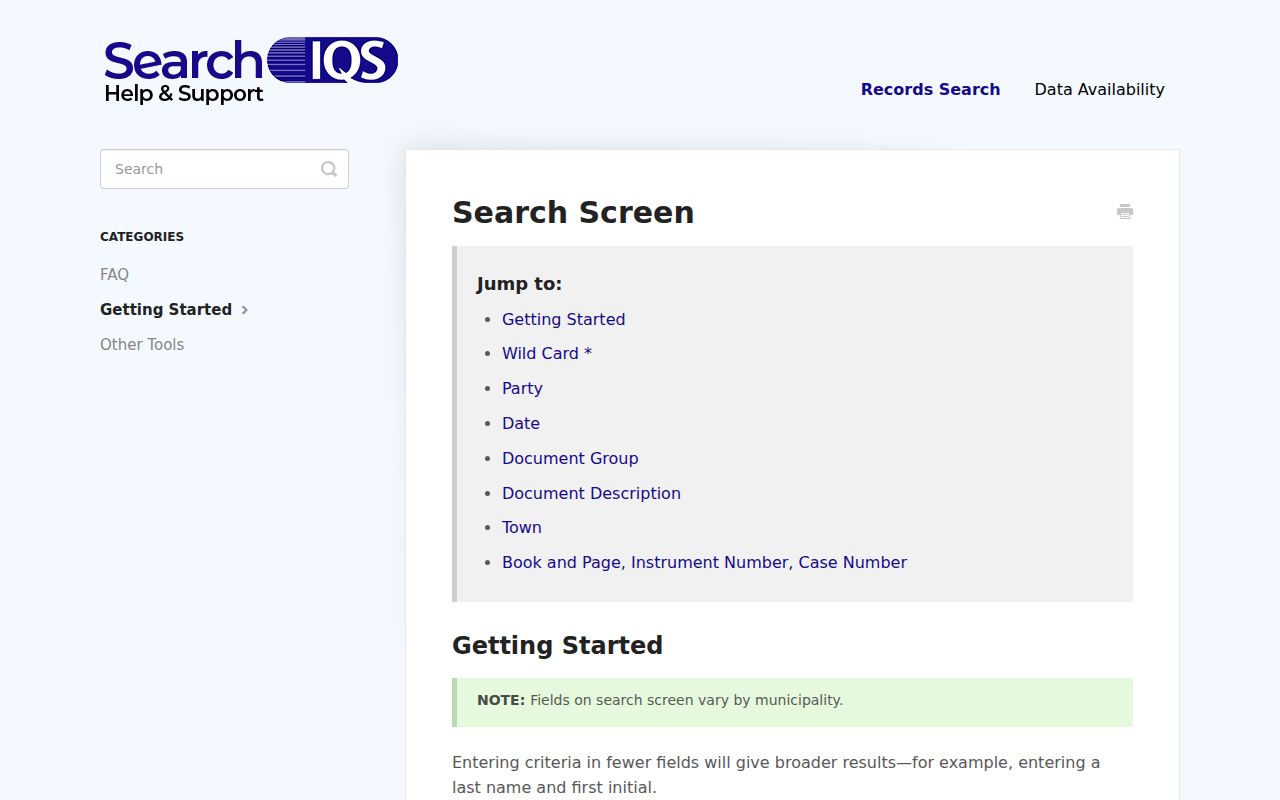
Use the image as a field guide, then verify the live availability and result behavior. If the portal does not expose an image, the Town Clerk can explain whether the book is available at the counter or through a copy request.
Note: SearchIQS index dates vary by source, so record the cutoff and ask the Town Clerk when an older image is missing.
1815 Books Behind Ridgefield Past Residents
The grantor/grantee books from 1815 through 1960 are the bridge between early land history and the modern SearchIQS index. They can carry party names and an index path even when a street address is not the best search key. An older name may appear in a deed description, map reference, or family connection rather than in the form used by a later parcel card.
SearchIQS Help and an older vendor PDF do not agree on several land and map image cutoffs. The older SearchIQS availability PDF gives different dates for some books, while the current Help page is the newer route. The practical tie-breaker is the Ridgefield Town Clerk land-record office. Ask about a missing book or image rather than treating a blank online result as a break in title history.
Namesake check. Ridgefield's fraud-alert route reports a deed, mortgage, or release filed under an exact name. A namesake is possible, so inspect the parcel and actual instrument before treating an alert as identity evidence.
The SearchIQS Ridgefield fraud-alert page is useful for spotting a filing, but it does not prove that the person named in the alert is the person connected to the address being studied.
Read Ridgefield Transfer Reports as Leads
The Town Clerk's property-transfer document center is a fast way to identify a recent month and then move to the recorded instrument. A July 2026 sample lists 07/01/2026, Book 1193, Page 114, 32 Lawson La, $370,000, an Executor Deed, and $925 in local conveyance tax. That row is a lead for a deed and legal description. It is not a title opinion, a complete ownership history, or proof that a grantee occupied the address.
After finding a row, open the corresponding SearchIQS instrument or ask the Town Clerk for the book and page. Compare the deed's legal description with the assessor card and map. The Town page says the last 30 days may be unaudited, which makes a second check especially important for a recent transfer.
Fees changed effective July 1, 2025. The posted schedule lists $70 for the first deed or mortgage page and $5 for each additional page. It also lists map fees of $20 for two parcels or fewer and $30 for more than two, a $1 page copy, and certified-copy charges of $2 per document plus $1 per page. Confirm the current schedule before traveling or ordering a copy.
Directories for Ridgefield Past Residents
Recorded parties are only one layer of earlier occupants. The Bridgeport History Center finding aid identifies Ridgefield volumes for 1958, 1960, 1962, 1964, 1966, 1968, 1973, 1975, 1977, 1979, 1981, 1983-84, 1986, and 1988-91. The finding aid describes alphabetical and street listings, with address, phone, occupation or place of work, spouse or death notes, and business or organization fields when present. It does not provide a complete digitized Ridgefield entry or a confirmed publisher for each year.
Use the Ridgefield city directory collections route when the research question is about the volumes themselves. For a single address, choose the closest available years, search by surname and initials, then turn to the street section. Write down the edition, page, address form, and any “see” reference. A missing volume or line is a gap to report, not evidence that nobody lived there.
The obituary index and Ridgefield Press microfilm can then test whether a directory name belongs to a family connected with the address. The RHS page gives an 1875-1999 index cutoff, while the Library guide says 1875-2005. Press Date is the newspaper issue date, not automatically a death date.
Note: A directory year places a listed person at one date; it does not prove the same household stayed through every edition.
Ridgefield Maps Before Modern Addresses
Three dated map layers make a Ridgefield house-history search more precise. Ridgefield Historical Society holdings include the 1867 Beers Atlas and the 1912 Whitlock map. The Library of Congress Sanborn resource presents the 1940 Ridgefield set of nine sheets, issued from August 1933 through March 1940. A map can show a building footprint, road route, or land-use context at that date.
Ridgefield research located no official townwide street-renumbering or annexation project. When an old number does not match the modern form, compare the directory street listing, the Town Clerk's home-history guide, deed description, map, and assessor parcel rather than naming a renumbering event without proof. Branchville, Ridgebury, Farmingville, and Titicus are useful local search clues, but they can describe a community area or historic place rather than a current administrative boundary.
Note: A dated map can bridge a road and a building, but it cannot establish present ownership or physical presence.
Trace Ridgefield Past Households
To move from ownership history to earlier households, pair the deed chain with a directory or census snapshot. The federal census can provide household context through 1950, but it is date-specific and the 1890 population schedules were lost. Later schedules remain subject to the federal 72-year restriction. A directory can fill a year between census snapshots, but it may list only selected people or a head of household.
Use this sequence for a name-and-address trail:
- Write down the current street spelling, number, unit if any, parcel or MBL, and the date of the record that supplied it.
- Choose the nearest available directory year and search the alphabetical listing by surname, initials, and spouse or maiden-name variants.
- Search the street section for the same number. Record every printed occupant, phone line, occupation or place-of-work field, and “see” reference without modernizing the entry.
- Pair the result with the closest census, Press issue, yearbook, obituary, cemetery, probate, or deed record whose date fits.
- Mark the end as a move, death, address change, missing publication, or unresolved identity question. Do not fill the gap with a guess.
Four definitions keep the roles separate:
- Grantor and grantee
- The grantor transfers an interest; the grantee receives it. Neither word alone says who lived at the address.
- Chain of title
- The linked sequence of recorded transfers for a parcel or legal description.
- Legal description
- The recorded land description that can remain useful when an old street number or road name changes.
- Criss-cross directory
- An address-first or street-order directory section that supplies a dated occupant lead.
- Enumeration district
- A census reporting area used to organize households at a particular census date; it is not a modern neighborhood boundary.
Ridgefield Previous Residents Beyond Online Indexes
The Ridgefield Town Clerk's historical land-record and genealogy page points to records reaching back to 1709 and to a “Tracing the History of Your Home” route. The Town Clerk is at 400 Main Street, phone 203-431-2783, with listed hours Monday through Thursday 8:00 a.m. to 5:30 p.m. and Friday closed. Ask for a book, map, image, or certified-copy route when the online chain stops. The office warns that it does not perform title searches or give legal advice.
The Town Clerk home-history guide is a practical image of the local fallback for past occupants when a portal result is incomplete.
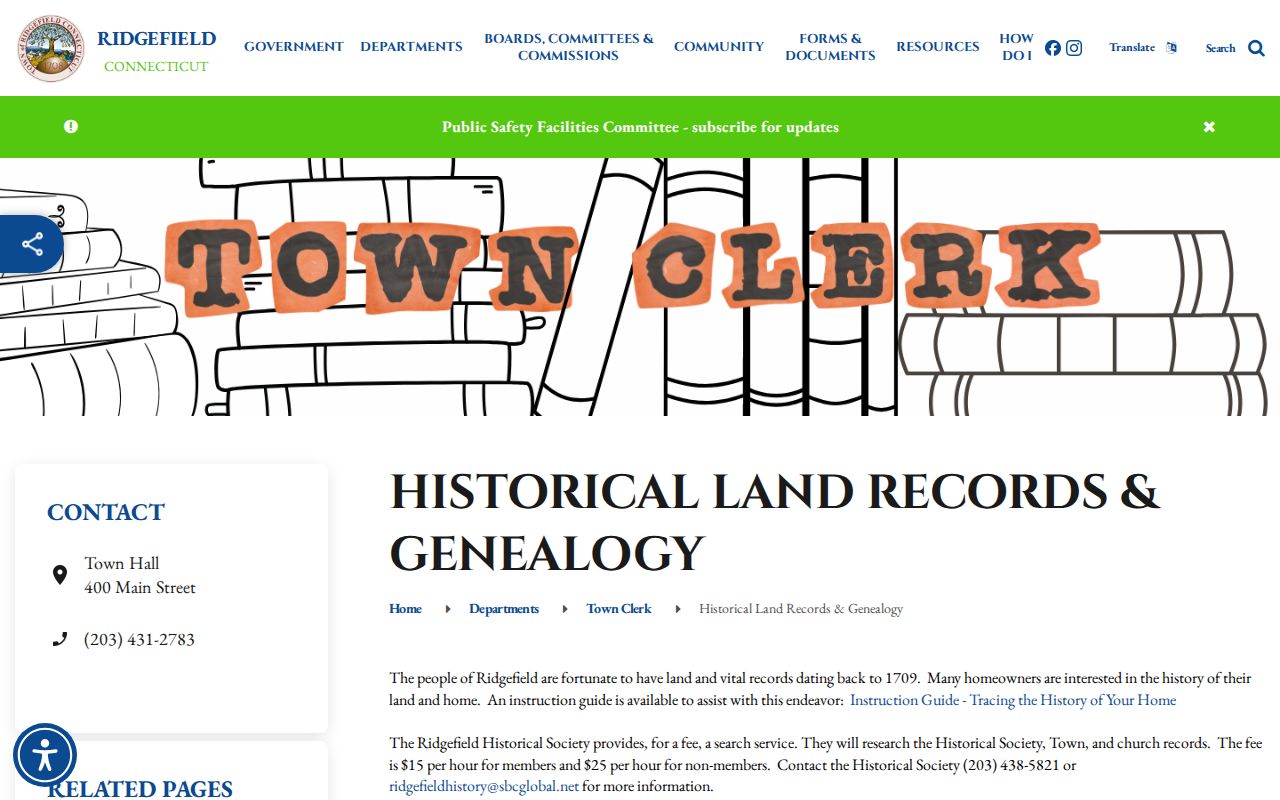
The image should be read as a research route, not as a substitute for the underlying deed, map, or genealogy record. The date and record type still belong beside every conclusion.
The Ridgefield Historical Society at 4 Sunset Lane, 203-438-5821, reports more than 10,000 pieces, including maps, yearbooks from 1945 forward, probate books, architectural files, family material, photographs, and Press volumes. Its research service lists $15 per hour for members and $25 per hour for nonmembers, image charges of $15 for members and $25 for nonmembers, upfront payment, and a possible turnaround of up to six months. The Ridgefield Library at 472 Main Street, 203-438-2282, extension 201, can be a faster first call for one Press issue or directory question.
If a state-held record is not available at the expected time, the Connecticut State Archives asks researchers to check access before traveling because 2026 compact-shelving work can place some off-site material out of reach. A written request under the Connecticut FOI Act, CGS sections 1-200 et seq., should go to the agency that maintains the record. Inspection may be a lower-cost first request than copies.
Ridgefield Past Residents Are Not Deed Parties
A deed party, an assessor owner field, a mailing name, an executor, a trustee, an occupant, and a previous resident are different roles. A transfer report can name a buyer or seller, while a directory can show a person at an address for one edition. A parcel card can identify a legal owner or entity, while a Press article may connect a family to a place after a move. Keep the role, date, and source separate.
Ridgefield assessor and GIS information can anchor a parcel, but it does not prove who is physically present. The same caution applies to a voter record, which is a registration record rather than proof of today's location. A protected address or confidential voter record should not be tested through another database. Stop when the source does not answer the question.
Lawful personal research. Previous-resident work is appropriate for house history, family history, genealogy, and personal curiosity. Do not use a name or address trail to stalk, harass, intimidate, or harm a living person.
That boundary also improves accuracy. A careful backward trail can still be rich, but it should end with an honest gap when the records do not establish who lived at a place.