
Ridgefield's City Directory Shelf
Ridgefield does not have one complete, public, searchable roll of every household. The useful material is divided among local history shelves, a regional finding aid, newspaper indexes, and historical maps. The Bridgeport History Center city-directory access page describes a Connecticut collection dated 1855 through 1990 and gives the best starting point for confirming which Ridgefield volumes are held. Its finding aid lists 1958, 1960, 1962, 1964, 1966, 1968, 1973, 1975, 1977, 1979, 1981, 1983-84, 1986, and 1988-91.
| Collection | Years or period | Where held | Access |
|---|---|---|---|
| Ridgefield city directories | 1958-1991, with listed gaps | Bridgeport History Center; Library and RHS leads | Physical or microfilm inquiry; no complete digitized run located |
| Ridgefield Press microfilm | 1875-present listed by the Library | Ridgefield Library; RHS bound volumes from 1930-2003 | Microfilm, bound volumes, and digital availability that varies by year |
| Obituary and death-notice index | RHS says 1875-1999; Library guide says 1875-2005 | Ridgefield Historical Society and Library follow-up | Online index plus article search on microfilm |
| Ridgefield yearbooks | 1945-present | RHS and Library local-history collections | Ask about in-person access or scan terms |
| Maps and architectural files | Early 1700s through early 2000s | RHS and Library local history | Research visit or paid Historical Society request |
The Bridgeport History Center city-directory page gives the public access route for the regional finding aid that names Ridgefield's intermittent runs.
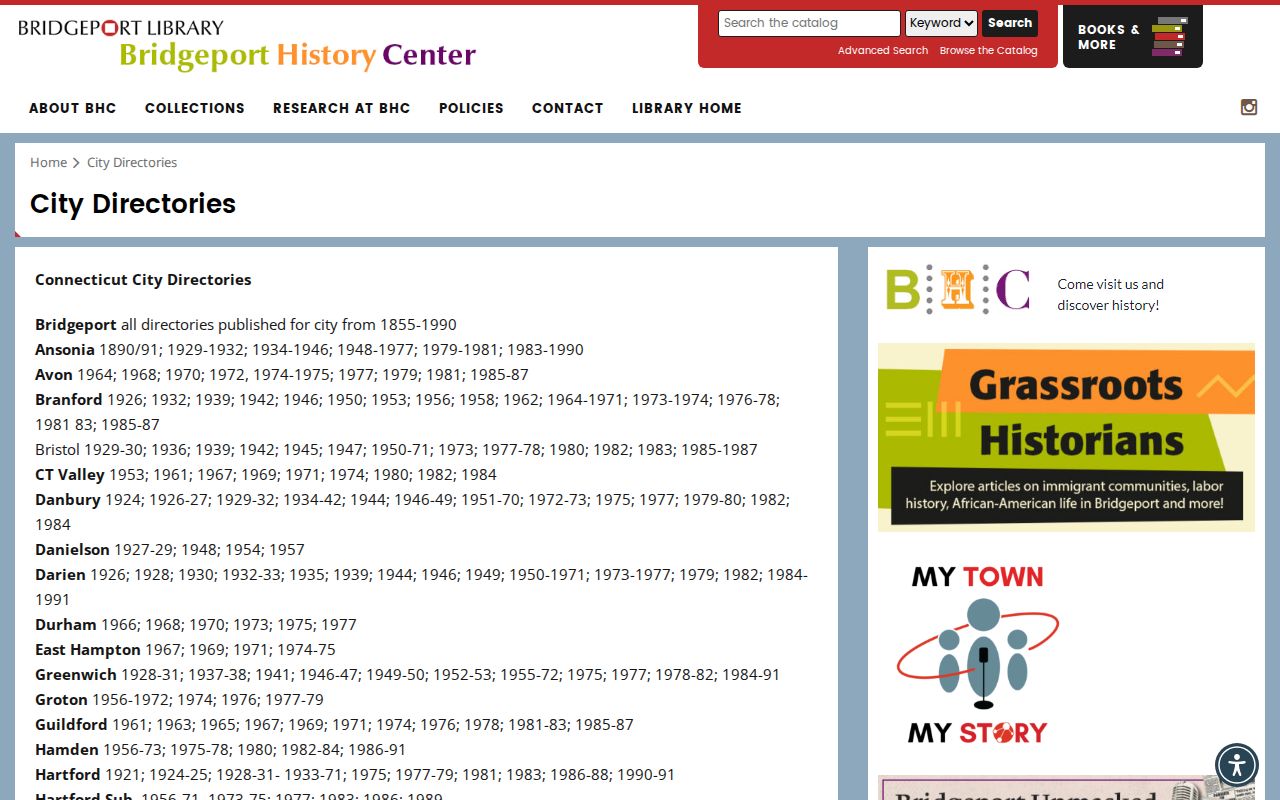
The finding aid image is a collection guide, not a digitized Ridgefield entry. Use it to identify the repository and then confirm the volume, year, and access method before relying on a listing.
The listed volumes are intermittent, and the finding aid does not assign a publisher to each Ridgefield edition. It names collection-level creators such as Price and Lee Co. and North American Directory Publishers, along with others. That is not enough to label every volume. A title page or a staff confirmation is the safe way to identify the publisher of a particular year.
Ridgefield's directory access is therefore a question of matching the right year to the right repository. A missing year may reflect an incomplete finding-aid inventory, an unlocated volume, or a publication gap. It does not show that no directory existed or that a family was absent from town.
Where Ridgefield Directory Volumes Sit
Ridgefield Library's local-history guide points to the upper-level collection, Ridgefield Press microfilm, an architectural survey, yearbooks, and local research help. The Library is at 472 Main Street, and the listed hours are Monday through Thursday 10:00 a.m. to 8:00 p.m., Friday 10:00 a.m. to 6:00 p.m., Saturday 9:00 a.m. to 5:00 p.m., and Sunday 1:00 p.m. to 5:00 p.m. Adult Services at 203-438-2282, extension 201, is the practical contact for a run-year or scan question.
The Library's local-history research guide also connects directory work to the Ridgefield Encyclopedia, the Ridgefield Timeline, digitized Press holdings, historical books, and databases. Its database list has filters for Connecticut, history, biographies, card-required, remote, and library-only access. Ancestry Library Edition, AmericanAncestors, and MyHeritage Library Edition are examples of resources whose access conditions should be checked before a visit. These tools can help with a census, directory, or yearbook lead, but a result still needs its year and source label.
The Ridgefield Library research guide is a useful image of that layered approach, with local history, Press, and timeline routes gathered beside one another.
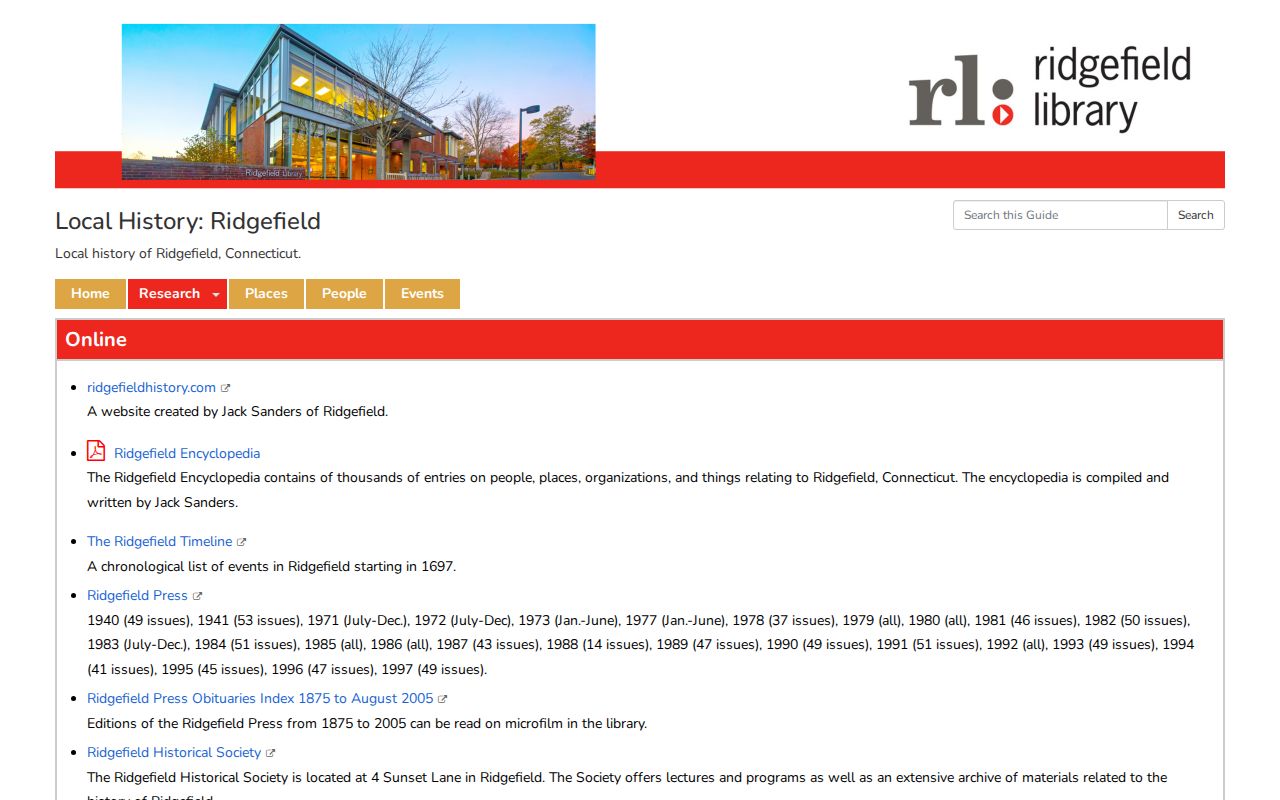
The guide does not turn the shelves into a complete online directory. It tells a researcher which local paths to ask about, and it helps connect a printed entry to a newspaper or historical record.
How Ridgefield City Directory Entries Read
A Ridgefield directory entry should be transcribed as a group of dated fields, not as a modern profile. The Bridgeport finding aid describes names, addresses, telephone numbers, occupations or places of work, and occasional spouse or death information. Business and organization listings may also appear. The actual Ridgefield page used for a particular year was not captured, so the title page, abbreviation key, and exact marks must be checked in the volume.
| Name | Alphabetical person or business name, including the initials and surname form printed in that edition. |
|---|---|
| Address and phone | Street address and telephone number when printed; record the exact spelling and number. |
| Occupation or place of work | Historical context attached to the entry, not proof of a present identity or location. |
| Spouse or death note | Some entries include a spouse reference or death date, which can guide a family-history check. |
| Street listing | An address-ordered path to earlier occupants in the 1895-and-later directory mechanics described by the finding aid. |
| Edition line | Year and publisher information from the title page; do not infer a publisher from a collection-level list. |
Three terms help keep the search precise. They describe how to read a volume, not features that were confirmed in every Ridgefield edition.
- Criss-cross directory
- An address-first or street-order section that lets a researcher move from a number and street to the names printed there.
- Householder index
- A name-first finding aid for household heads or listed people. Check the volume's own label before assuming that every household appears.
- Abbreviation key
- The volume's legend for short forms and symbols. Photograph or transcribe it before interpreting an occupation, relationship, or address mark.
Because no digitized Ridgefield sample page was available, do not invent an owner mark, a residence symbol, or a line-by-line example. A clean transcription preserves what the source actually prints and leaves uncertain marks flagged for a librarian.
Note: A directory mark should be copied from the volume's key, because collection-level descriptions do not define every edition's symbols.
Alphabetical Names Versus Street Listings
The two sections answer different questions. An alphabetical listing starts with a surname, initials, or business name and points toward an address. A street listing starts with a road and number and points toward the people or organizations printed there. The Bridgeport finding aid says Connecticut directories use both forms beginning in 1895. That makes the street section especially valuable when a surname is misspelled, a spouse is listed differently, or the question begins with an old address.
Ridgefield's listed run is not a complete reverse directory. No official digitized reverse or telephone-directory run was located, and a street listing in a historical volume is not the same thing as a modern reverse-search database. Ask the Library or History Center to inspect the physical or microfilm volume for the relevant year. Keep the address, year, page, and section together so another researcher can repeat the search.
When a road name changes form, compare the directory with the Beers, Whitlock, Sanborn, and current parcel layers described below. The research file located no official townwide renumbering or annexation project, so a mismatch remains a question to test rather than a fact to repeat.
Note: A person missing from one section or year may reflect an incomplete volume, a variant spelling, or a gap in the holdings.
Ridgefield Press and Obituary Leads
The Ridgefield Historical Society obituary and death-notice index exposes four useful fields: Last name, Name, birth year, and Press Date. Press Date means the date of the newspaper issue, not necessarily the date of death. The first roughly forty years have missing issues, and the Society's page gives an 1875-1999 cutoff while the Library guide gives 1875-2005. Treat that difference as a live access question.
Search a married name, maiden name, spouse form, and initial variant. Record every Press Date, then ask the Library for the matching microfilm issue or ask the Society about its research service. A short index row may signal a longer notice, especially when a likely birth year is present. It is a lead to a historical person, not a current address.
The Ridgefield obituary index shows how a historical directory search can support family-history or reconnection work without collapsing an old newspaper clue into a present resident claim.
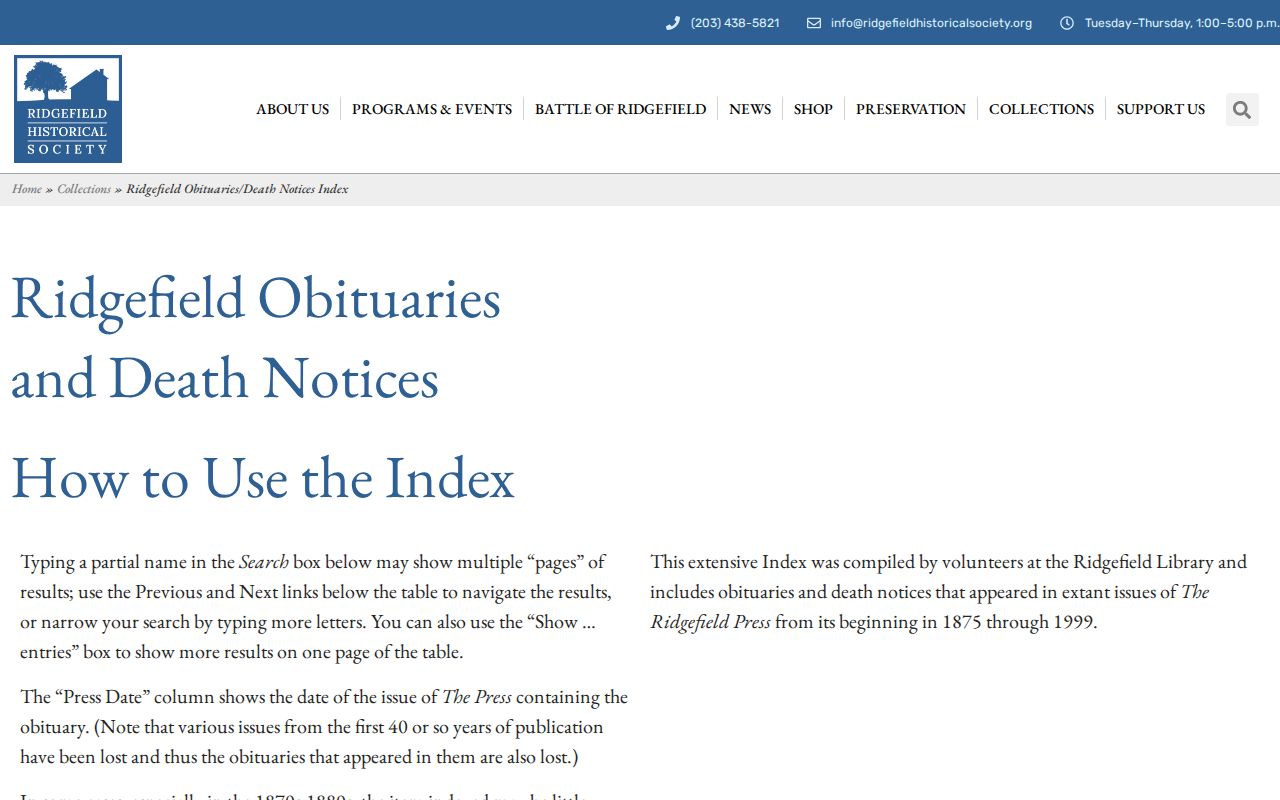
The image reflects an index route rather than a full article archive. Follow the displayed name and date into the Press collection, then compare the result with a directory year, cemetery record, probate file, or family paper.
Ridgefield Maps Beside Directory Research
Maps add a place layer when a printed address no longer matches the modern street form. Ridgefield Historical Society holdings include the 1867 Beers Atlas, the 1912 Whitlock map, modern street maps, historic-district and open-space material, and architectural files. The Library of Congress Ridgefield Sanborn map resource covers a dated 1940 set of nine sheets, issued from August 1933 through March 1940. These sources can show a route, building footprint, or land use at a known date.
None of those maps proves who lives at a parcel now. Pair the map date with the directory edition, deed description, Press article, or assessor parcel ID. Local names such as Branchville, Ridgebury, Farmingville, Titicus, East Ridge, and Main Street can be valuable search terms, but they may describe an area, route, historic district, or community reference rather than a formal boundary.
Ridgefield Library's local-history collection brings maps, architectural research, newspapers, and yearbooks into the same research setting.
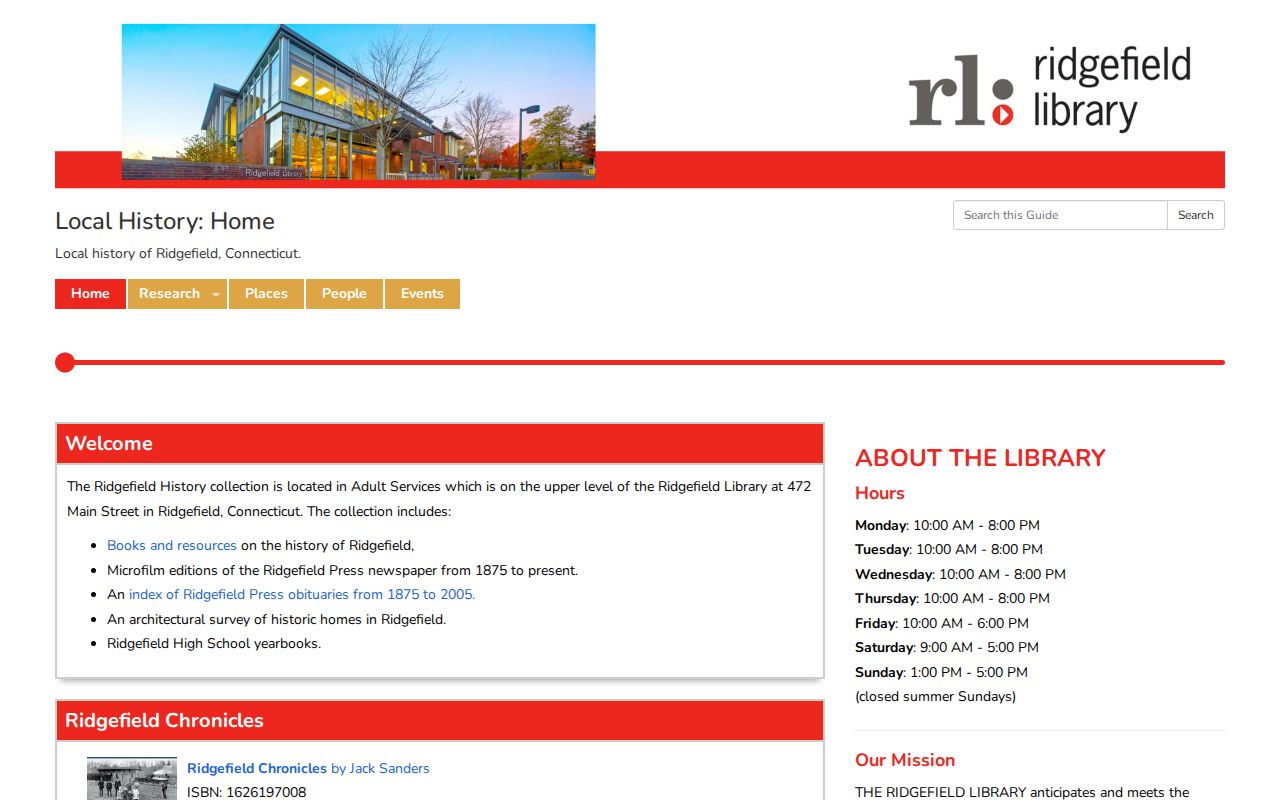
That combination is most useful when a directory gives an old number and a map gives the surrounding road pattern. The result should still state which source supplied each part of the address story.
Trace Family Names Through Ridgefield City Directories
A household trace works best when each directory year is treated as a dated snapshot. The earliest listed Ridgefield volume is 1958, while the federal census can supply older household snapshots through 1950. The National Archives 1950 Census release explains the 1950 digital release and the 72-year rule for later schedules. The 1890 population schedules were lost, so a gap around that decade needs newspaper, vital, cemetery, map, or family-file support.
Use the following order, keeping a source note beside every name and address:
- Choose the closest available directory years around the event or move being studied, and write down the volume title and page.
- Search the alphabetical section by surname, initials, maiden or married form, then copy the address, phone, and any relationship or death notation.
- Turn to the street section for the same number and road. Note a different spelling, rural-route form, “see” reference, or missing year.
- Pair the result with a census snapshot, Press issue, yearbook, cemetery entry, probate file, or deed whose date fits the question.
- Explain the ending as a documented move, death, address change, or unresolved gap rather than assuming what a missing line means.
A directory entry can connect a name to a date and street, but the strength of that connection depends on the edition and the companion record. When a current question needs confirmation, the modern Ridgefield resident lookup route uses different custodians and access rules.
Ridgefield Timeline and Encyclopedia Clues
The Ridgefield Library Timeline begins in 1697 and places people, roads, organizations, and events in a local sequence. The Ridgefield Encyclopedia adds entries about places, institutions, families, and community history. These resources can supply a date or spelling that makes a city directory search easier, especially when a surname appears in more than one form.
Use a timeline entry as a lead, then look for the dated source behind it. A person named in an encyclopedia entry may be connected to a Press issue, a yearbook, a map, a probate book, or a directory volume. A road reference may need the Beers, Whitlock, or Sanborn map before it can be matched to a current parcel. Preserve the source title and date rather than blending the clue into a single biography.
The Ridgefield local-history collection guide is the best starting point for matching the Timeline, Encyclopedia, Press, maps, yearbooks, and library-held directory clues.
Note: A timeline can orient a search, but the dated volume or newspaper entry still supplies the household evidence.
Korker Photos for Ridgefield Directory History
The Korker Photo Shop collection adds a visual way to test a historical address lead. Ridgefield Historical Society materials describe photographs and negatives made from 1951 through 1991, with about 2,600 negatives scanned by 2025 and an estimated 30,000 to 35,000 negatives in the larger collection. A storefront, civic event, school group, or house image can help connect a directory name to a date, but the caption and collection record control what the photograph proves.
The Historical Society's Korker digitization update describes the ongoing work and the scale of the collection. It is a timely reminder that some Ridgefield history is becoming easier to discover while much of the underlying material remains in an archive or requires a staff request.
Compare a photograph with the directory year, Press coverage, map layer, and family record. Do not identify an unlabeled person from resemblance alone, and do not assume that a building visible in a photograph had the same occupant throughout the decade. The strongest result states the image date, collection, caption, and the separate record that supplies the name or address.