
Finding Ridgefield Residents by Record
Treat a Ridgefield residents directory search as a short chain of stops rather than one broad name hunt. Decide first what you actually want. Is it a current property lead, a registered-voter question, a historical household, a family connection, or an estate matter? The answer decides which office can speak to it. An assessor card ties a name to a parcel. It proves ownership, not occupancy. A street directory can place a household at an address for a single year. It cannot confirm a present address. Log the exact spelling, source date, address form, and record role as you go. Connecticut keeps no single Fairfield County resident counter for Ridgefield land records. The Town Clerk, Assessor, registrars, courts, Library, Historical Society, and state agencies each hold one piece of the picture.
- Write the known name, street, unit, parcel or time period, then add maiden, married, middle-initial, and spelling variants.
- Use the Ridgefield property card or AxisGIS to make a non-sensitive parcel or address anchor.
- Check the relevant Connecticut lookup, such as SOTS voter records, Judicial dockets, Probate, or a vital-record request route.
- For a past household, pair the address with a listed directory year, Press issue, obituary, map, cemetery, or probate record.
- Ask the named custodian for inspection or a copy when the online index is blocked, incomplete, or outside its date range.
Note: A property owner, registered voter, recorded party, and directory entry are different source roles, and honest results keep them apart.
Where Ridgefield Resident Records Are Kept
Ridgefield is a Connecticut town. Its Town Clerk serves as the recording office for local deeds, mortgages, maps, vital records, trade names, and other municipal papers. Fairfield County can point you to regional courts and repositories. It cannot replace the Town Clerk for any Ridgefield land instrument. The Assessor and the registrars answer different questions entirely. Probate matters route to PD45 in Bethel, which handles the Northern Fairfield County district.
Ridgefield Town Clerk
Town Hall, 400 Main Street
Ridgefield, CT 06877
203-431-2783
Land records and SearchIQS route
Ridgefield Assessor
Town Hall, lower level
Ridgefield, CT 06877
203-431-2706
Assessor office and cards
Ridgefield Registrars
Local voter administration
Ridgefield, CT 06877
203-431-2771 / 2772
SOTS voter privacy route
The Library covers the historical side of Ridgefield resident records. The Historical Society does too, from old newspapers to indexed obituaries. Probate cases for the town go to PD45, the Northern Fairfield County Probate District. State offices supply the wider channels. When a local record is not the right fit, statewide vital, voter, court, and licensing sources take over. Criminal-history sources step in as well.
Choose the Ridgefield Record for the Question
The word "resident" can hide several different aims. A family historian may need a deceased person's obituary. They may also need the probate file. Someone tracing a property history wants the parcel and the deed parties. Historic maps help too. A voter question belongs with SOTS. A local registrar can help as well. A birth-family search runs through Connecticut DCF's consent-based process, never through a public name search.
| Question | Best first record | What it can show | What it cannot prove |
|---|---|---|---|
| Who is tied to a parcel? | Assessor/eQuality | Owner name, situs, MBL, use, sales and card fields | Who occupies the property today |
| Was someone registered? | SOTS or registrar | Public registration, party, status, and allowed participation fields | Physical presence or full household membership |
| Who was at an old address? | Directory, Press, map | A dated name, address, phone, or place clue | A current address or complete life story |
| Who handled an estate? | PD45 Probate lookup | Case number, type, filed date, district, and public case fields | That the person lived in Ridgefield |
| How can family reconnect? | DCF Reunion Registry | A consent and non-identifying information route | An unrestricted identity or address disclosure |
The right record keeps a result honest. A name in one source is only a lead. Add a second independent field, such as a date, parcel, obituary birth year, or directory address, and the connection grows stronger without erasing the source's limits.
Search Ridgefield Parcels by Owner or Address
The Ridgefield eQuality property-card search is the most detailed local starting point for parcels. It offers Property Search and Sales Search tabs. The property form takes an owner name in last-name-first order. It also accepts location number, street name, unit, MBL, unique identifier, property use, and condominium complex. The live street list is exhaustive. It runs from Catoonah Street and Danbury Road to Branchville Road, High Ridge Avenue, and George Washington Highway. A last name alone gives the broadest owner search. The result is parcel evidence, not a live resident roll. Visible columns include Street Name, Number, Unit, Name, Uniqueid, MBL, Property Use, Acres, Zone, Buildings, and Condo Complex. The card page states its data was updated June 30, 2026. It explains that assessed value reflects 70 percent of estimated market value at the 2022 revaluation. Sales searches add filters for property type, sale date and price ranges, acreage, MBL, zone, design type, living area, year built, rooms, bedrooms, and baths. One public municipal row illustrates the fields. It shows MAIN ST, RIDGEFIELD TOWN OF, Uniqueid E150262, MBL E15-0262, Residential, 4.1800 acres, zone RA, three buildings. That row is useful for learning the layout. It is not evidence that a private person lives there. Read the eQuality page before trusting a result. Then compare the parcel against the map and the recorded instrument. Keep owner, mailing, situs, taxpayer, and occupant as separate labels.
| eQuality field | Why it matters |
|---|---|
| Owner Name (Last First) | Search key for the card’s named owner or entity. |
| Location number and street name | Current situs search fields, with a unit field for multi-unit records. |
| MBL and Unique Identifier | Parcel anchors that can survive street-name spelling differences. |
| Property Use, Acres, Zone, Buildings | Assessment and land-context fields, not an occupancy statement. |
Note: The Assessor processes transfers and confirms property lines, but a card alone never proves a person's current physical presence.
The image comes from the Ridgefield Assessor property-card page and shows the parcel interface used for Ridgefield resident research.
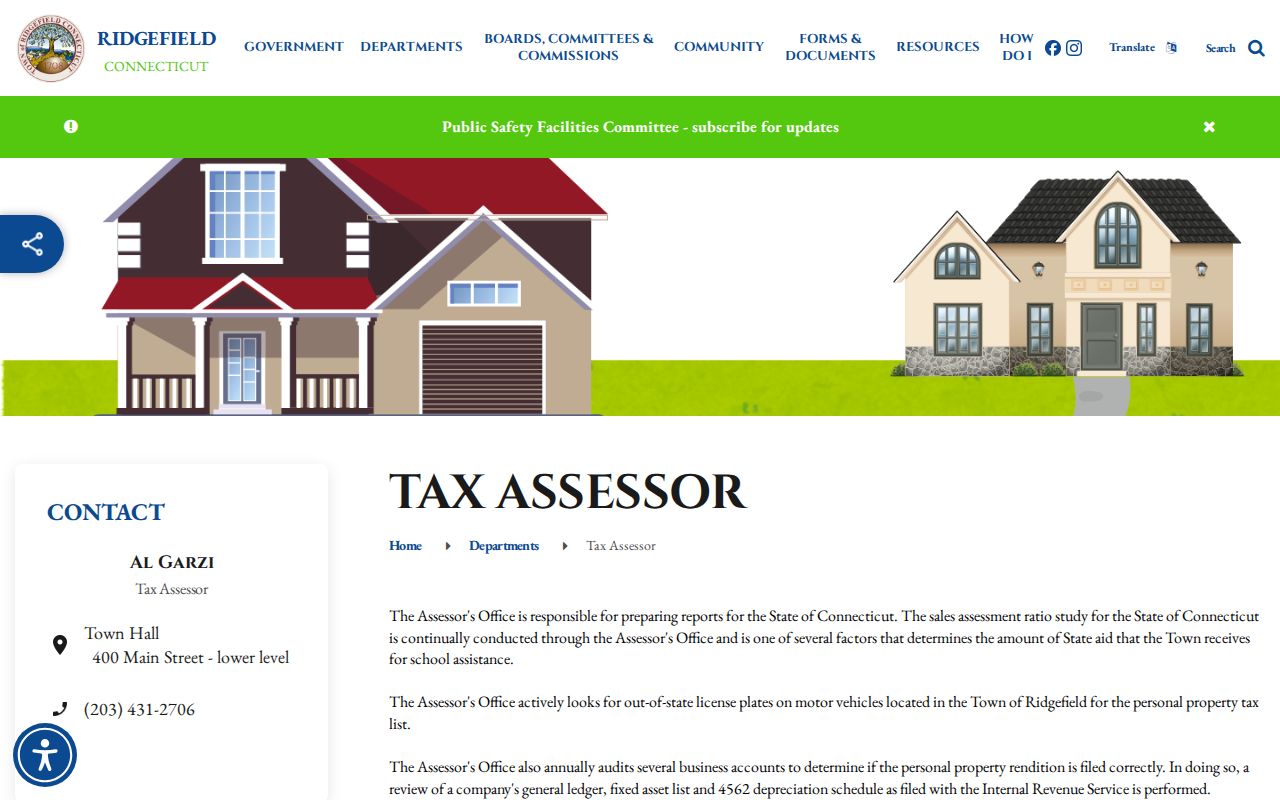
The card view supplies a structured parcel lead. Cross-check its date and source role before setting it beside a name.
Ridgefield Voter Records and the Public Lookup
Connecticut's Secretary of the State runs one registration system for every town, so the state's individual lookup is the practical starting point for a narrow registration question. The full registry file works differently. That route is a separate written request. Where allowed, public materials describe name, residence and mailing fields, party or unaffiliated status, active or inactive status, and participation history. Participation history updates within 60 days after an election or primary.
The current 2026 rule leaves birth year public. Birth month and day are exempt. The SOTS CSV request costs $300. It uses a written form and requires certification for election-related, scholarly, journalistic, political, or governmental purposes. Personal, private, commercial, marketing, reproduction, display, and harassment uses are barred. The broad file is no shortcut for one person.
Use the lookup only within its live terms. If a protected result is hidden, stop. Connecticut's Address Confidentiality Program and the voter nondisclosure process can substitute or suppress an actual street and house number. The image below links to the official Connecticut individual voter lookup, and its presence does not turn a public voter record into proof of current occupancy.
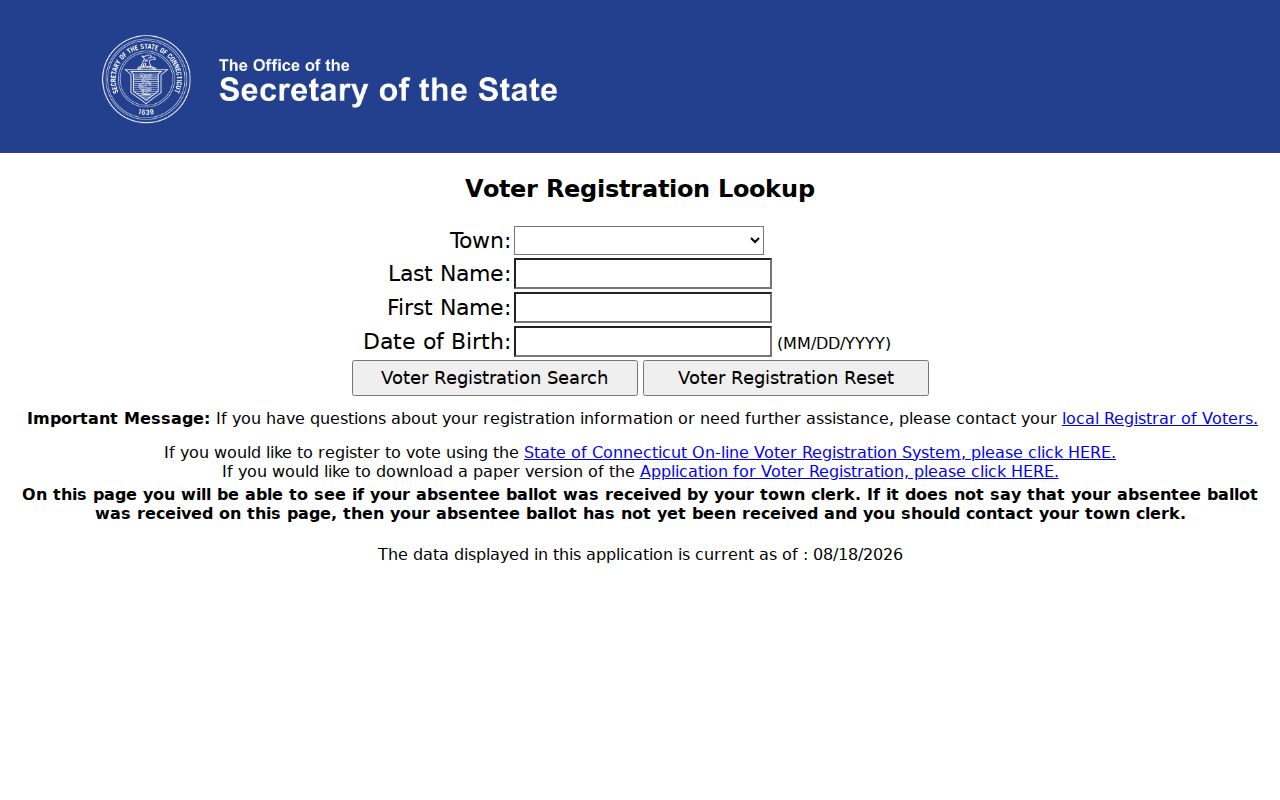
Keep the lookup date and each source's registration role. A voter record can be inactive, protected, recent, or tied to a mailing address that differs from a parcel.
Privacy boundary. A public voter route is not a household list. Do not use it to test, expose, or triangulate a protected address.
Ridgefield Town Clerk Land Records
The Town Clerk's land-record page connects to SearchIQS for owner-name and party searches. The Help section maps out the search fields. Options include Party 1, Party 2, an "ignore party type" toggle, date-from and date-through fields, Document Group, Document Description, Town, Book/Page, Instrument Number, and Case Number. A wildcard helps with a broad name. Exact book and page or instrument numbers can pin down a known deed.
The current Help page reports a land index running from September 8, 1959 to the present, with images from May 31, 1890 forward and an associated-books caveat. Grantor and grantee index books span 1815 through 1960. The Town page starts owner names at 1960. An older vendor PDF gives different image cutoffs. When a period does not line up, the current Help page and the Town Clerk are the tie-breakers.
Start with a parcel or a known party. Then search both sides of the transfer. Record the instrument number, book, and page. Add the recording date, document type, parties, consideration or tax if shown, and any referenced map. The latest 30 days may lack audit. The office does no title searches or legal advice. Confirm current fees, certified copies, maps, and the exact instrument with the custodian.
The SearchIQS Ridgefield land-record portal is the online route. The Town Clerk remains the fallback for office inspection and certified copies.
Note: An exact-name fraud alert reports a filing under a name; it is not identity verification and can belong to a namesake.
Ridgefield Vital Records by Event
Birth, marriage, and death records answer an event question, not a general resident-directory question. Ridgefield's Town Clerk holds the local event records. Mail requests with identification and payment work when required. Connecticut DPH keeps statewide records from July 1, 1897 forward. The town where the event occurred is often the faster route. State processing can take up to 12 weeks.
Birth records under 100 years carry restricted eligibility. The state birth form asks for the full name, date and town of birth, parent names, requester identity, relationship and reason, copy type and count, payment, and ID. A birth or fetal-death record at least 100 years old is generally open under CGS §7-51a and related genealogy rules. Anyone 18 or older can generally buy certified marriage and death copies, subject to Social Security number and other redactions.
The official Connecticut vital-record forms show the access route. The image below is a linked form source. It is not a personal certificate.
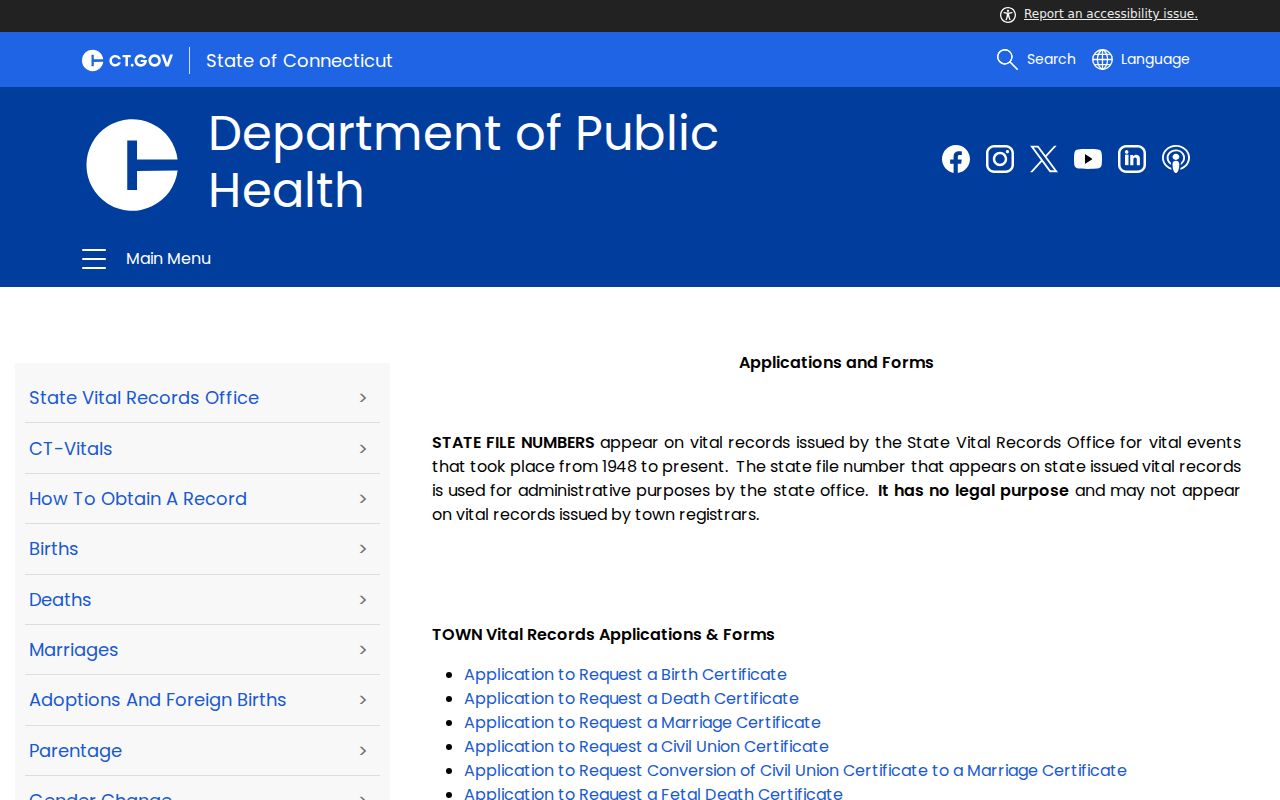
Use an obituary or directory only as a lead. Certified copies may be restricted. Keep the difference between an index fact and the record held by the Town Clerk or DPH.
Ridgefield's Current Resident Sources
No official public book lists every Ridgefield resident. The pieces exist, though, and each one is partial. Together they form a Ridgefield residents directory only when each record's role stays visible: assessor and tax portals give property or billing names, SearchIQS indexes recorded parties, and SOTS holds registration data under strict public-use rules. Ridgefield Newcomers keeps a membership directory. Its charter limits the directory and activity-group lists to online members only.
| Source | Record role | Keeper | Access note |
|---|---|---|---|
| eQuality property card | Owner, parcel, use, sales fields | Ridgefield Assessor | Online card search, not occupancy proof |
| Tax-bill portal | Taxpayer, property number, property name | Ridgefield Tax Collector | Name and property tabs, no household claim |
| SearchIQS land index | Grantor, grantee, deed and map parties | Ridgefield Town Clerk | Online index plus office fallback |
| SOTS voter route | Registration and allowed status fields | Connecticut Secretary of the State | Individual lookup and restricted CSV terms |
| Newcomers directory | Member community information | Ridgefield Newcomers | Member-only, not a public resident roll |
Match the source to the question first. Seek a second source only when the record is public and the purpose is lawful. A tax name can be a billing lead. A deed party can be a seller, trust, executor, or buyer. Neither label should be silently rewritten as "resident." Precision improves fast with a paired detail. A parcel, date, obituary birth year, case number, or directory year turns a loose hit into a firm trail, and that is the line between a directory lead and a claim about a person.
Ridgefield Court and Probate Records
Connecticut Judicial Branch searches answer case questions, not household-list questions. The criminal defendant form requires a last name to begin. Birth year, year range, court location, and case type stay optional. Pending filters cover criminal, motor vehicle, and referred license matters. A search that returns nothing settles nothing about a Ridgefield resident. Treat a blank screen as an unanswered question rather than a fact.
Estates and trusts run through probate. The Connecticut Probate case lookup offers several fields. These cover Case Type, District, status, first name, and last name. Ridgefield belongs to PD45, the Northern Fairfield County Probate District, seated in Bethel. Online decedent-estate and trust results generally begin January 5, 2011. Older returns run incomplete. A typical row shows case number, name, type, filed date, and district. Keep in mind that a probate row proves a court file, not a Ridgefield residence.
Civil inquiry carries its own party, docket, property-address, and attorney modes. Public e-file coverage generally starts with civil return dates of January 1, 2014. Older, family, sealed, and protected material may require a courthouse trip or stay unavailable altogether. Erased qualifying criminal matters under CGS §54-142a deserve better than rumor. Never reconstruct them from silence.
The image comes from the Connecticut Judicial defendant search. It shows the form route itself rather than any person-specific result.
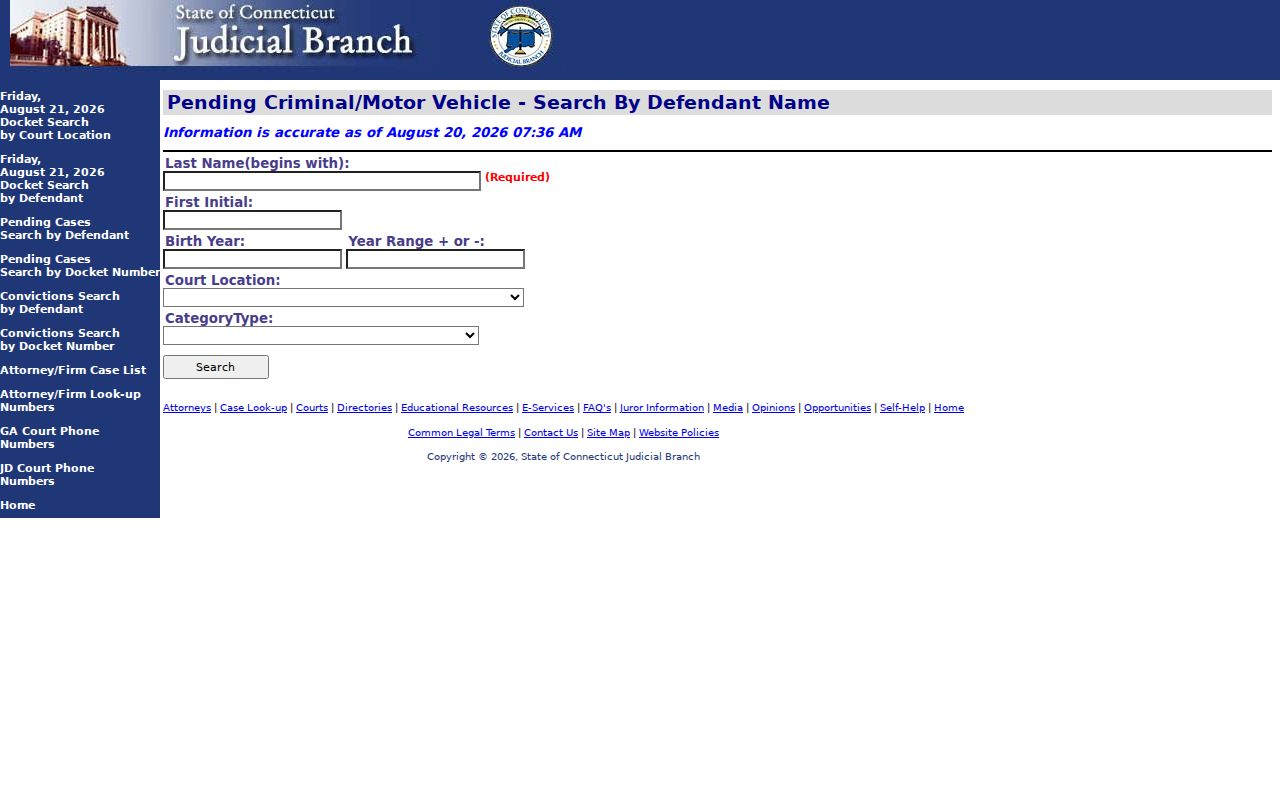
Match the court, case number, date, disposition, and identity before any court record attaches to a name.
Ridgefield's Historical Resident Trail
Ridgefield's historical record trail spreads across many dated sources. The Library holds Ridgefield Press microfilm from 1875 forward. It also keeps local yearbooks, an obituary index, an architectural survey, and a local-history collection. The Historical Society adds maps, house files, probate books, photos, oral histories, and Press volumes. The Bridgeport History Center finding aid offers the sharpest city-directory run list anywhere. It still stops short of a complete digitized Ridgefield series.
The Library's searchable Timeline reaches back to 1697. The Ridgefield Encyclopedia profiles people, places, organizations, and events. Try a name or road there first. Then confirm the date against Press microfilm, a directory, or a deed. A map or a formal record can serve too. A Library guide, catalog record, or obituary index marks a holding or a lead. It is not the record itself.
Ridgefield's visual history has a recent layer too. The Historical Society is digitizing the Korker Photo Shop negatives. About 2,600 were scanned by 2025, from an estimated 30,000 to 35,000 in the collection. A photograph can tie a building, event, or family name to a date. Its caption and collection record still control what can be claimed.
For the full year-by-year shelf, use the Ridgefield city directory collections page. Keep modern parcel work separate from historical occupant evidence.
Ridgefield Family History and Heir Leads
A resident search can serve family history without exposing anyone living. For a deceased Ridgefield resident, begin with the Historical Society obituary index. Note every Press Date. Then follow the Library's microfilm route to the article. Layer cemetery, vital, probate, directory, deed, and family-file evidence in date order. The Barbour Collection's volume 36 holds Ridgefield names from 1709 through 1850. It sits at the Library reference desk. That volume bridges early family research neatly.
Adoption and birth-family questions follow a consent-based path. Connecticut DCF runs a Reunion Registry and adoption-search forms. These serve eligible adult adoptees, birth parents, and birth relatives. The process turns on identity proof, notarization, and agency routing. Mutual consent comes before any identifying contact. Adoptions since 1944 route through DCF. Pre-1944 matters go through the Probate Court involved. This path is about family connection, never a public address tool.
The Connecticut DCF Reunion Registry keeps the route anchored to family connection and safety. When a record is restricted, the custodian's eligibility process is the proper next step. Skip substitute databases.
- Roll
- A list kept for a defined purpose, such as voter registration, not a complete town census.
- Index
- A finding aid that points to a record or image and may omit fields found in the original.
- Parcel
- A mapped property unit identified by a local number, MBL, or unique card ID.
- Criss-cross directory
- A historical directory arranged by address or street as well as by person, useful for past households.
Note: The safest family-history trail leans on dated, role-specific sources and stops short of exposing a living person's protected information.
Ridgefield Privacy and Address Safety
Connecticut's Freedom of Information Act opens existing non-exempt public records. It does not force an office to build a resident list or reveal protected fields. A request should name the custodian, date range, and record type. It should also give the address or parcel and whether inspection suffices. Municipal copy rules can differ from state or judicial rules. A custodian may still redact or withhold material under an exemption.
Safe at Home is Connecticut's Address Confidentiality Program. It gives qualifying participants a substitute address and mail-forwarding route. The actual address stays sealed except under listed legal exceptions. Voter nondisclosure under CGS §9-50d can strip street and house details from a public display. Similar protected-record rules can do the same. Describe a substitute address as exactly that, nothing more.
Connecticut stalking law reaches repeated monitoring, observing, surveilling, harassing, or communicating through any method. Use public records for lawful personal research, genealogy, civic understanding, and safety-aware access. Never use them to track, harass, or harm another person. That line does not bend.
Use a custodian first. If a person says an address is protected, stop the search and give the official SOTS or Safe at Home route. Do not triangulate the location through a parcel, voter, map, or directory record.
Tracing Ridgefield Residents Through History
Ridgefield city directories survive in a Brid report from the Bridgeport History Center. Its finding aid lists volumes for 1958, 1960, 1962, 1964, 1966, and 1968. Later volumes cover 1973, 1975, 1977, 1979, 1981, 1983–84, 1986, and 1988–91. The collection holds alphabetical name listings, and street listings by address appear from 1895 onward. One entry might carry a name, an address, and a phone. It may also list an occupation or workplace, notes on a spouse or a death, and business or group ties. Gaps break that run of years. The finding aid names no publisher for each Ridgefield volume. A missing year proves nothing. It does not mean no book existed, nor that a person stayed away. Ask the Library, the Historical Society, the Bridgeport History Center, or the Connecticut State Library. They can help with physical copies, microfilm, and finding-aid access.
Two local collections make the past residents of Ridgefield easier to trace. The Ridgefield Library local-history collection holds Press material, yearbooks, and local guides worth a follow-up visit. The Ridgefield Historical Society collections add maps, photographs, and probate, house, and family files. Work the alphabetical section first for a name. Then work the street section for the address. Anchor whatever you find with a dated record. The Ridgefield obituary and death-notice index is a good example. It records a historical name lead before you request the full Press article.
The image below opens the Ridgefield Town Clerk land-record page. That records office stands behind the dated deed trail.
The old directory shelf and the Town Clerk's deed trail work best side by side. A deed names the recorded parties to a property. A directory entry gives a household clue in time. Use both, and a resident lookup in Ridgefield gets much steadier.
Recent Ridgefield Records Initiatives
Ridgefield records access keeps shifting in small, documented ways. The Historical Society's Korker digitization project adds a large visual-history archive. The Town Clerk's land page reflects the July 1, 2025 fee change. It came under Public Act 25-168. Monthly transfer PDFs from 2024 through 2026 give a fresh lead stream. Each transfer still needs its recorded instrument to mean anything. The Connecticut State Archives posted a 2026 compact-shelving notice. An item can appear in a finding aid. Yet it may sit off site or be briefly unavailable. Call the State Library or Archives before you drive over. The state's voter-file disclosure dispute also ended in a July 2026 dismissal. Restricted birth fields and SOTS use terms remain in force.