
Finding Ridgefield Residents by Record
A Ridgefield residents directory search works best as a short chain, not as one broad name hunt. First decide whether the goal is a current property lead, a registered-voter question, a historical household, a family connection, or an estate matter. The answer controls which office can speak to the question. An assessor card can tie a name to a parcel. It cannot prove occupancy. A directory can place a household at an address for one year. It cannot prove a present address.
Keep the exact spelling, source date, address form, and record role in a small worksheet. Connecticut has no single Fairfield County resident counter for Ridgefield land records. The Town Clerk, Assessor, registrars, courts, Library, Historical Society, and state agencies each hold a different piece.
- Write the known name, street, unit, parcel or time period, then add maiden, married, middle-initial, and spelling variants.
- Use the Ridgefield property card or AxisGIS to make a non-sensitive parcel or address anchor.
- Check the relevant Connecticut lookup, such as SOTS voter records, Judicial dockets, Probate, or a vital-record request route.
- For a past household, pair the address with a listed directory year, Press issue, obituary, map, cemetery, or probate record.
- Ask the named custodian for inspection or a copy when the online index is blocked, incomplete, or outside its date range.
Note: A property owner, registered voter, recorded party, and historical directory entry are separate source roles and should stay separate in any result.
Where Ridgefield Resident Records Are Kept
Ridgefield is a Connecticut town, and its Town Clerk is the recording office for local deeds, mortgages, maps, vital records, trade names, and other municipal records. Fairfield County helps locate regional courts and repositories, but it does not replace the Town Clerk for a Ridgefield land instrument. The Assessor and registrars answer different questions, while PD45 in Bethel handles Northern Fairfield County probate matters.
Ridgefield Town Clerk
Town Hall, 400 Main Street
Ridgefield, CT 06877
203-431-2783
Land records and SearchIQS route
Ridgefield Assessor
Town Hall, lower level
Ridgefield, CT 06877
203-431-2706
Assessor office and cards
Ridgefield Registrars
Local voter administration
Ridgefield, CT 06877
203-431-2771 / 2772
SOTS voter privacy route
The Library and Historical Society fill the historical side of Ridgefield resident records. Probate cases for Ridgefield route to PD45, Northern Fairfield County Probate District. State offices supply statewide vital, voter, court, licensing, and criminal-history channels when a local record is not the right fit.
Choose the Ridgefield Record for the Question
The word “resident” can hide several different research aims. A family historian may need a deceased person’s Press notice and probate file. Someone checking a property history may need the parcel, deed parties, and historic maps. A voter question belongs with SOTS or a local registrar. A birth-family search should go through Connecticut DCF’s consent-based process, not through a public name search.
| Question | Best first record | What it can show | What it cannot prove |
|---|---|---|---|
| Who is tied to a parcel? | Assessor/eQuality | Owner name, situs, MBL, use, sales and card fields | Who occupies the property today |
| Was someone registered? | SOTS or registrar | Public registration, party, status, and allowed participation fields | Physical presence or full household membership |
| Who was at an old address? | Directory, Press, map | A dated name, address, phone, or place clue | A current address or complete life story |
| Who handled an estate? | PD45 Probate lookup | Case number, type, filed date, district, and public case fields | That the person lived in Ridgefield |
| How can family reconnect? | DCF Reunion Registry | A consent and non-identifying information route | An unrestricted identity or address disclosure |
Using the right record keeps a result honest. A name in one source is a lead. A second independent field, such as a date, parcel, obituary birth year, or directory address, makes the connection stronger without erasing the source’s limits.
Search Ridgefield Parcels by Owner or Address
The Ridgefield eQuality property-card search is the most detailed local property starting point. It has Property Search and Sales Search tabs. The property form accepts an owner name in last-name-first order, location number, street name, unit, MBL, unique identifier, property use, and condominium complex. The street list is exhaustive in the live form, with examples such as Catoonah Street, Danbury Road, Branchville Road, High Ridge Avenue, and George Washington Highway. A last name alone is the broadest owner search.
The result is parcel evidence, not a live resident roll. Its visible columns include Street Name, Number, Unit, Name, Uniqueid, MBL, Property Use, Acres, Zone, Buildings, and Condo Complex. The card page says its data was updated June 30, 2026, and explains that assessed value reflects 70 percent of estimated market value at the 2022 revaluation. Sales searches add property type, sale date and price ranges, acreage, MBL, zone, design type, living area, year built, rooms, bedrooms, and baths.
A public municipal sample used in the research returned MAIN ST, RIDGEFIELD TOWN OF, Uniqueid E150262, MBL E15-0262, Residential, 4.1800 acres, zone RA, and three buildings. That row is useful for learning the fields. It is not evidence that a private person lives there.
Read the Ridgefield eQuality property-card search before using a result, then compare the parcel with the map and recorded instrument. Keep owner, mailing, situs, taxpayer, and occupant as separate labels.
| eQuality field | Why it matters |
|---|---|
| Owner Name (Last First) | Search key for the card’s named owner or entity. |
| Location number and street name | Current situs search fields, with a unit field for multi-unit records. |
| MBL and Unique Identifier | Parcel anchors that can survive street-name spelling differences. |
| Property Use, Acres, Zone, Buildings | Assessment and land-context fields, not an occupancy statement. |
Note: The Assessor processes transfers and confirms property lines, but the card itself does not establish a person’s current physical presence.
The following image comes from the Ridgefield Assessor property-card page and shows the parcel interface used for Ridgefield resident research.
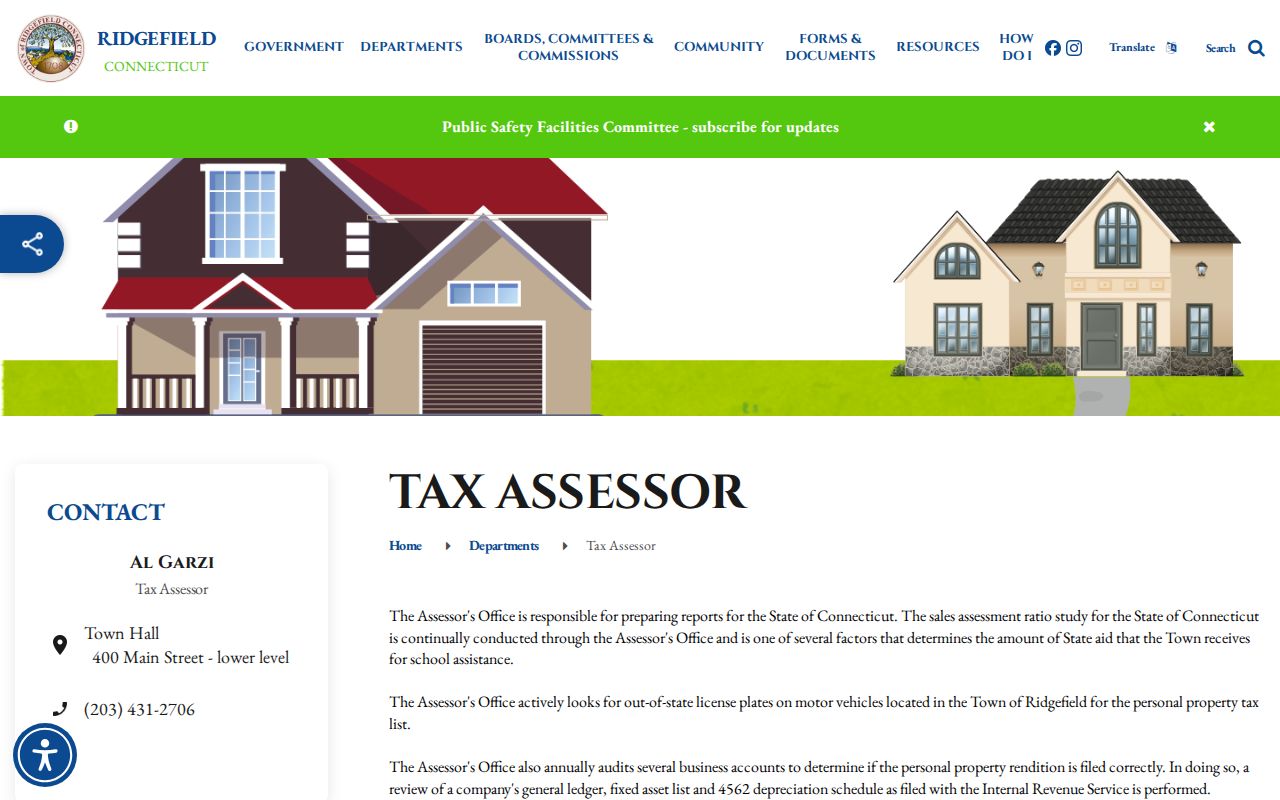
The card view supplies a structured parcel lead. Cross-check the card date and source role before using it beside a name.
Ridgefield Voter Records and the Public Lookup
Connecticut’s Secretary of the State runs the centralized voter-registration system for all towns. The individual lookup is the practical starting point for a narrow registration question, while the registry-file route is a different written request. Public materials describe name, residence and mailing fields when allowed, party or unaffiliated status, active or inactive status, and participation history. Participation history is updated within 60 days after an election or primary.
The current 2026 rule leaves birth year public while making month and day of birth exempt. The SOTS CSV request costs $300, uses a written form, and requires certification for election-related, scholarly, journalistic, political, or governmental purposes. The form bars personal, private, commercial, marketing, reproduction, display, and harassment uses. A broad file request is not a shortcut for one person.
Use the Connecticut voter lookup only within its live terms. If a protected result is hidden, stop. Connecticut’s Address Confidentiality Program and voter nondisclosure process can substitute or suppress an actual street and house number.
The image below links to the official Connecticut individual voter lookup. Its presence does not turn a public voter record into proof of current occupancy.
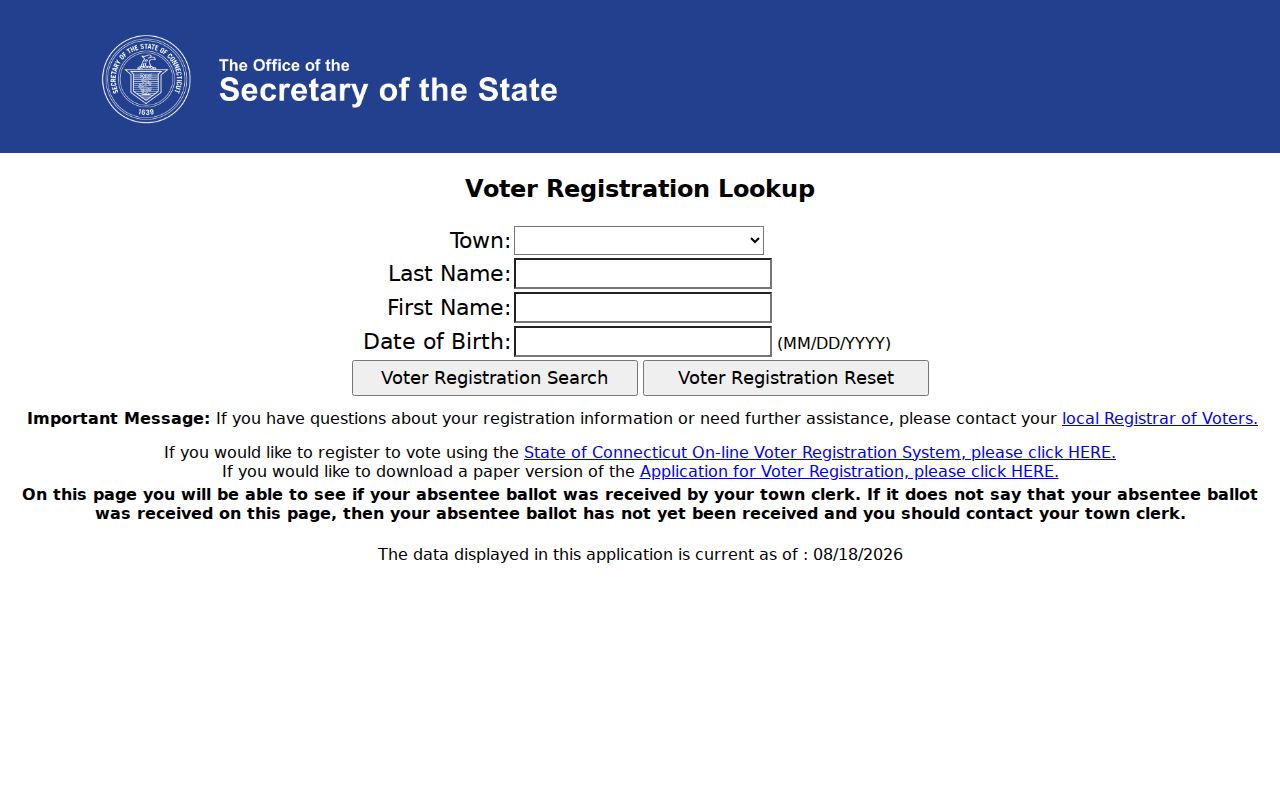
Keep the lookup date and the source’s registration role with any note. A voter record can be inactive, protected, recent, or tied to a mailing address that differs from a parcel.
Privacy boundary. A public voter route is not a household list. Do not use it to test, expose, or triangulate a protected address.
Ridgefield Town Clerk Land Records
The Town Clerk’s land-record page links to SearchIQS for owner-name and party searches. SearchIQS Help lists Party 1, Party 2, an “Ignore party type” option, date-from and date-through fields, Document Group, Document Description, Town, Book/Page, Instrument Number, and Case Number. A wildcard can help with a broad name, while exact book and page or instrument numbers can narrow a known deed.
The current Help page reports a land index from September 8, 1959 to the present and images from May 31, 1890 to the present, with an associated-books caveat. It also lists grantor/grantee index books from 1815 through 1960. The Town page advertises an owner-name period beginning in 1960. An older vendor PDF gives different image cutoffs, so the current Help page and the Town Clerk are the tie-breakers when a period does not line up.
Start with a parcel or known party, then search both sides of a transfer. Record the instrument number, book, page, recording date, document type, parties, consideration or tax if shown, and referenced map. The Town Clerk warns that the latest 30 days may not be audited and does not perform title searches or give legal advice. Current fees, certified copies, maps, and the exact instrument should be confirmed with the custodian.
The SearchIQS Ridgefield land-record portal is the online route. The Town Clerk remains the fallback for office inspection and certified copies.
Note: An exact-name fraud alert reports a filing under a name; it is not identity verification and can belong to a namesake.
Ridgefield Vital Records by Event
Birth, marriage, and death records answer an event question, not a general resident-directory question. The Ridgefield Town Clerk keeps local event records and accepts local requests by mail with identification and payment when required. Connecticut DPH maintains statewide records from July 1, 1897 forward. The local town where the event occurred is often the faster route, while state processing can take up to 12 weeks.
Birth records under 100 years have restricted eligibility. The state birth form asks for the full name, date and town of birth, parent names, requester identity, relationship and reason, copy type and count, payment, and ID. A birth or fetal-death record at least 100 years old is generally open under CGS §7-51a and related genealogy rules. Anyone 18 or older can generally buy certified marriage and death copies, subject to Social Security number and other redactions.
The official Connecticut vital-record forms show the access route. The image below is a linked form source, not a personal certificate.
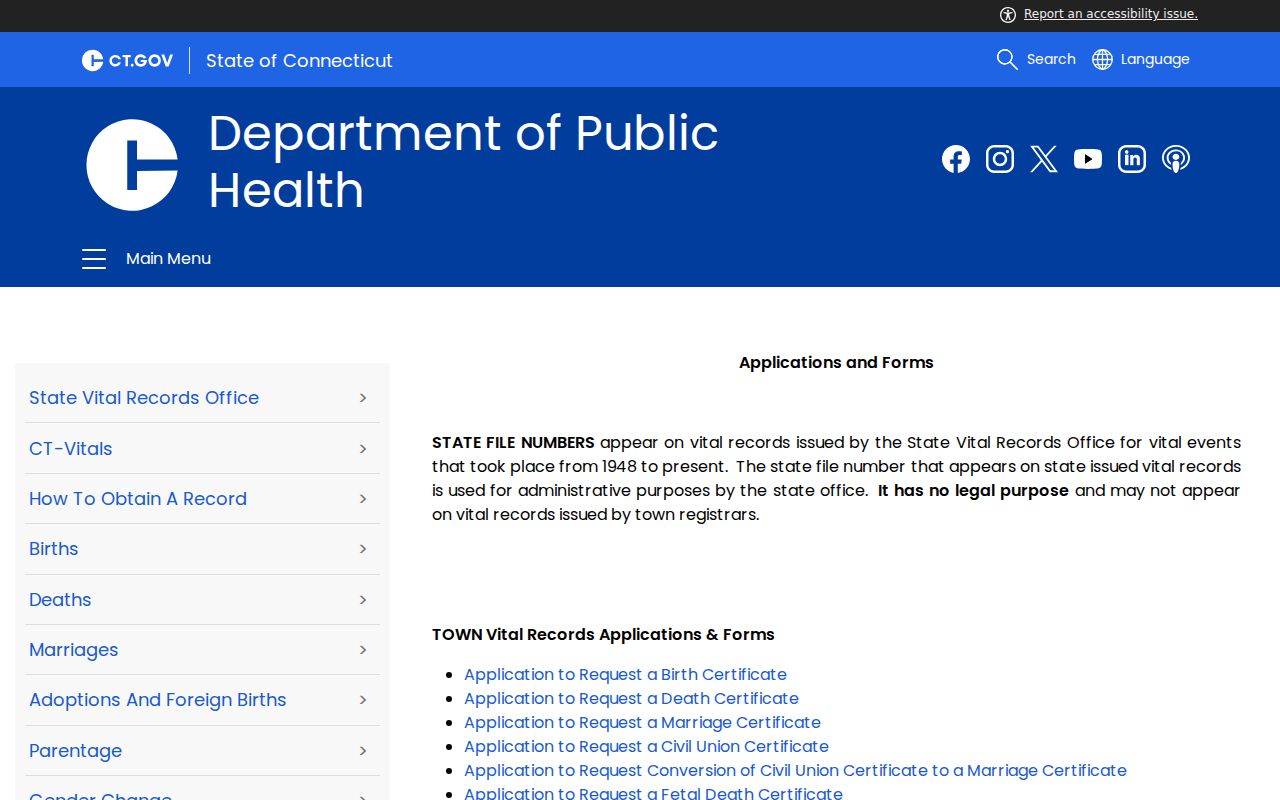
Use an obituary, cemetery record, or directory only as a lead when a certified copy is restricted. Preserve the difference between an index fact and the record held by the Town Clerk or DPH.
Ridgefield's Current Resident Sources
No official public book lists every Ridgefield resident. Together, these partial sources form a Ridgefield residents directory only when each record role stays visible. The assessor and tax portals point to property or billing names. SearchIQS indexes recorded parties. SOTS holds registration data under strict public-use rules. Ridgefield Newcomers has a membership directory, but its charter says the directory and activity-group lists are online only for members.
| Source | Record role | Keeper | Access note |
|---|---|---|---|
| eQuality property card | Owner, parcel, use, sales fields | Ridgefield Assessor | Online card search, not occupancy proof |
| Tax-bill portal | Taxpayer, property number, property name | Ridgefield Tax Collector | Name and property tabs, no household claim |
| SearchIQS land index | Grantor, grantee, deed and map parties | Ridgefield Town Clerk | Online index plus office fallback |
| SOTS voter route | Registration and allowed status fields | Connecticut Secretary of the State | Individual lookup and restricted CSV terms |
| Newcomers directory | Member community information | Ridgefield Newcomers | Member-only, not a public resident roll |
Use the source that fits the question, then seek a second source only when the record is public and the purpose is lawful. A tax name can be a billing lead. A deed party can be a seller, trust, executor, or buyer. Neither label should be silently rewritten as “resident.”
The current search trail becomes more precise when a name is paired with a parcel, date, obituary birth year, case number, or directory year. That is the difference between a directory lead and a claim about a person.
Ridgefield Court and Probate Records
Connecticut Judicial Branch searches are useful when the question is a public case, not when the goal is a general household list. The criminal defendant form uses a required last name that begins with the supplied text, optional birth year and year-range fields, court location, case type, and a Search button. Pending filters include criminal, motor vehicle, and referred license matters. The research capture found no selected Ridgefield-named defendant result, so a blank or unreviewed screen should not be turned into a fact.
For estates and trusts, the Connecticut Probate case lookup offers Case Type, District, status, first name, and last name fields. Ridgefield is served by PD45, Northern Fairfield County Probate District, in Bethel. Online decedent-estate and trust results generally begin January 5, 2011, with incomplete older returns. Results can show case number, name, type, filed date, and district. A probate row proves a court file, not a Ridgefield residence.
Civil inquiry has its own party, docket, property-address, and attorney modes. Public e-file coverage generally starts with January 1, 2014 civil return dates, while older, family, sealed, and protected material may require courthouse access or remain unavailable. Erased qualifying criminal matters under CGS §54-142a should not be reconstructed from absence or rumor.
The image below comes from the Connecticut Judicial defendant search and shows a form route, not a person-specific result.
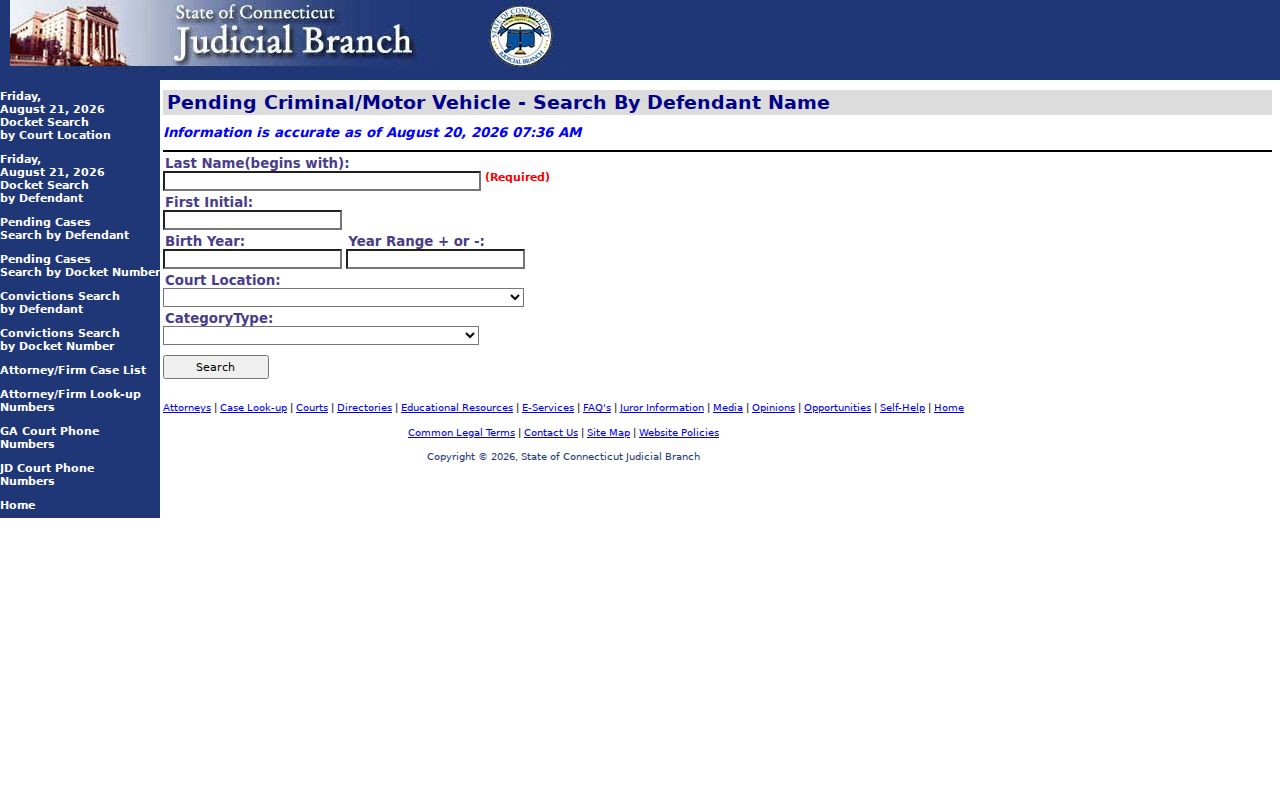
Verify the court, case number, date, disposition, and identity before attaching a court record to a name.
Ridgefield's Historical Resident Trail
The historical record trail for Ridgefield is unusually spread across dated sources. The Library lists Ridgefield Press microfilm from 1875 forward, local yearbooks, an obituary index, an architectural survey, and a local-history collection. The Historical Society adds maps, house files, probate books, photos, oral histories, and Press volumes. The Bridgeport History Center finding aid supplies the most specific city-directory run list, but it does not provide a complete digitized Ridgefield series.
The Ridgefield Library’s searchable Timeline begins in 1697, and the Ridgefield Encyclopedia has entries on people, places, organizations, and events. Search a name or road there, then confirm the date in Press microfilm, a directory, a deed, a map, or a formal record. A Library guide, catalog record, or obituary index is evidence of a holding or lead. It is not the full record itself.
Ridgefield’s visual history also has a recent layer. The Historical Society is digitizing the Korker Photo Shop negatives, with about 2,600 scanned by 2025 and an estimated 30,000 to 35,000 negatives in the collection. A photograph can connect a building, event, or family name to a date, but its caption and collection record still control what can be claimed.
For the full year-by-year directory shelf, use the Ridgefield city directory collections page and keep modern parcel work separate from historical occupant evidence.
Ridgefield Family History and Heir Leads
A resident search can serve a family-history purpose without exposing a living person. For a deceased Ridgefield resident, start with the Historical Society obituary index, note every Press Date, and follow the Library’s microfilm route for the article. Add cemetery, vital, probate, directory, deed, and family-file evidence in date order. The Barbour Collection’s volume 36 includes Ridgefield names from 1709 through 1850 and is held at the Library reference desk, making it a useful bridge to early family research.
For adoption and birth-family questions, Connecticut DCF provides a Reunion Registry and adoption-search forms for eligible adult adoptees, birth parents, and birth relatives. The process uses identity proof, notarization, agency routing, and mutual consent for identifying contact. Connecticut adoptions since 1944 route through DCF, while pre-1944 matters go through the Probate Court involved. This is a consent-based path, not a public address tool.
The Connecticut DCF Reunion Registry keeps the route tied to family connection and safety. If a record is restricted, the correct next step is the custodian’s eligibility process, not a substitute database.
- Roll
- A list kept for a defined purpose, such as voter registration, not a complete town census.
- Index
- A finding aid that points to a record or image and may omit fields found in the original.
- Parcel
- A mapped property unit identified by a local number, MBL, or unique card ID.
- Criss-cross directory
- A historical directory arranged by address or street as well as by person, useful for past households.
Note: The safest family-history trail uses dated, role-specific sources and stops when a living person’s protected information would be exposed.
Ridgefield Privacy and Address Safety
Connecticut’s Freedom of Information Act gives access to existing non-exempt public records, but it does not require an office to create a resident list or disclose protected fields. Requests should identify the custodian, date range, record type, address or parcel, and whether inspection is acceptable. Municipal copies may have different limits from state or judicial copies, and a custodian can redact or withhold material under an exemption.
Safe at Home, Connecticut’s Address Confidentiality Program, gives qualifying participants a substitute address and mail-forwarding route. The actual address is not released except under listed legal exceptions. Voter nondisclosure under CGS §9-50d and other protected-record rules can remove street and house information from a public display. A substitute address must remain a substitute address in any description.
Connecticut stalking law covers repeated conduct such as monitoring, observing, surveilling, harassing, or communicating through any method. Public records should be used for personal, lawful research, genealogy, civic understanding, and safety-aware record access. They should never be used to track, harass, or harm another person.
Use a custodian first. If a person says an address is protected, stop the search and give the official SOTS or Safe at Home route. Do not triangulate the location through a parcel, voter, map, or directory record.
Tracing Ridgefield Residents Through History
The Bridgeport History Center finding aid lists Ridgefield city-directory volumes for 1958, 1960, 1962, 1964, 1966, 1968, 1973, 1975, 1977, 1979, 1981, 1983–84, 1986, and 1988–91. The collection describes alphabetical listings and, from 1895 onward, street listings by address. A typical entry may include a name, address, telephone number, occupation or place of work, spouse or death notes, and business or organization information.
Those years have gaps. The finding aid does not assign a publisher to each Ridgefield volume, and no digitized line entry or official reverse-directory run was captured. A missing year does not show that no book existed or that a person was absent. Ask the Library, Historical Society, Bridgeport History Center, or Connecticut State Library about physical, microfilm, and finding-aid access.
The Ridgefield Library local-history collection is the practical shelf for Press, yearbooks, local guides, and follow-up. The Ridgefield Historical Society collections add maps, photographs, probate, house, and family material. Search the alphabetical section for a person, then the street section for an address, and bridge the result with a date-stamped source.
The Ridgefield obituary and death-notice index shows how a historical name lead is recorded before the full Press article is requested.
The following image links to the Ridgefield Town Clerk land-record page, the local source behind the dated deed trail.
The dated Town Clerk record trail complements the old directories. Deeds show recorded parties, while the directory shelf supplies a point-in-time household clue. Neither source alone answers every resident question.
Recent Ridgefield Records Initiatives
Ridgefield records access is changing in small, documented ways. The Historical Society’s Korker digitization adds a large visual-history project. The Town Clerk’s land page reflects the July 1, 2025 fee change under Public Act 25-168. Monthly transfer PDFs from 2024 through 2026 offer a recent lead stream, but each transfer still needs the recorded instrument.
Connecticut State Archives issued a 2026 compact-shelving notice. A finding aid can show that an item exists while the item remains off site or temporarily unavailable. Contact the State Library or Archives before making a trip. The state’s voter-file disclosure dispute also ended in a July 2026 dismissal, but restricted birth fields and SOTS use terms remain in force.
These updates matter because a Ridgefield resident-record result has a date. Record when a portal, fee schedule, transfer list, digitization page, or archive notice was checked. If the source is dynamic or blocked, say so and use the custodian’s fallback instead of filling the gap with a guess.